
September 3, 2024
By Rev. Dr. Scott Field, President of the Wesleyan Covenant Association
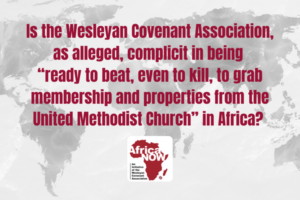 United Methodist Insight and the United Methodist Africa Forum should immediately retract, refute, and apologize for this reckless and dangerous lie.
In the wake of actions by the recent United Methodist General Conference redefining Christian marriage to include same-sex couples and deleting the sexual behavior standard of “celibacy in singleness and fidelity in marriage” for ordained clergy, the United Methodist Church in Africa has been experiencing significant internal discord. Reports from a variety of sources, official, unofficial, online, social media, special interest groups, and the like, are confusing and conflicting.
Despite the unsettled nature of the developing situation in Africa, two reports, both connected to the same partisan source, assert that the Wesleyan Covenant Association is “fomenting unrest throughout Africa by claiming the UMC has become a “gay church.” Pastor Gabriel Banga Mususwa, General Secretary of the United Methodist Africa Forum, in his essay highlighted in United Methodist Insight, goes far beyond “fomenting unrest”; he writes of the “divisive forces”:
“They’re ready to beat, even to kill, to grab membership and properties from the United Methodist Church.”
That’s a very serious allegation to place at the feet of the WCA. It is also false. Even more, it is reckless, defamatory, and dangerous. A retraction and apology by both UM Insight and The United Methodist Africa Forum should be issued immediately; their own integrity is on the line.
 What’s Going on Here?
Two reliably progressive sources, United Methodist Insight and United Methodist Africa Forum include the denominational name “United Methodist” as, I imagine, something of a “credibility enhancer”. Neither of them is actually funded by or accountable to the United Methodist Church. They are, however, closely aligned with progressive influencers, leaders, caucuses, and causes within the United Methodist Church.
Cynthia Astle, formerly a long-time religion writer with the now-defunct United Methodist Reporter, is founder and editor of the online publication United Methodist Insight. She authored a news article published last week in the Baptist News about the contentious situation among United Methodists in Africa. In the article, she quoted from an essay by Pastor Gabriel Banga Mususwa of Zambia, who is General Secretary of the unofficial caucus United Methodist Africa Forum. Ms. Astle writes that Pastor Mususwa alleges the Wesleyan Covenant Association is “fomenting unrest throughout Africa by claiming the UMC has become a ‘gay church’”.
We should note, before addressing Pastor Mususwa’s allegation directly, that the group he represents, United Methodist Africa Forum, is a more recently formed caucus group launched to directly oppose Africa Initiative, a network of traditionalist, evangelical, orthodox, Wesleyan United Methodists in Africa. (For more on the development of the Africa Forum as a reaction against the Africa Initiative, see Odell Horne, Jr: The Scramble for Africa.). The point here is simply that Pastor Mususwa is a partisan activist advocating for the progressive positions passed by the UMC at the recent General Conference; he opposes the witness and ministry of traditionalists in the UMC.
Note, for a moment, the “breadcrumb trail” that elevates a reckless and incendiary opinion to the status of “fact”:
First, Pastor Mususwa’s opinion essay is carried in the online journal established and edited by Ms. Astle. It is promoted as a “Special to United Methodist Insight”, as if it is late-breaking news. Both United Methodist Africa Forum and United Methodist Insight, remember, despite adopting the denominational name, are actually led by activist progressives who oppose the traditionalists of the UMC.
Next, the allegation made by Pastor Mususwa is included in what is ostensibly a news article in the Baptist News Global Online authored by Ms. Astle. We should note that Ms. Astle does indeed have a notable history as a religion reporter whose work has also been carried in the National Catholic Reporter as well as occasionally in Baptist News Global. Her article in question here was carried by our Baptist friends in the “news” section of their online journal rather than the “analysis” or “opinion” sections. The result? An opinion essay, containing dubious and reckless allegations, becomes a “news article” through independent Baptist media. A person could be excused for concluding this was a piece of fact-based journalism. It most clearly is not.
But this egregious overreach of allegations raises an important clarifying question.
What is the source of the dissension and disruption among African United Methodists?
The source of dissension and disruption within African United Methodism lies in the dramatic decisions of the United Methodist Church during its April/May General Conference in Charlotte, North Carolina. The approval of the LGBTQIA+ agenda by the General Conference is celebrated by some, particularly USA bishops and UMC leaders, as a long overdue victory for justice. These same decisions are also abhorrent to many, in Africa certainly, but also among traditionalist/orthodox/evangelical Wesleyans overall. The General Conference decisions are regarded as a repudiation of Scriptural authority and an abandoning of Christian moral standards. Without question this has shocked many United Methodists and has caused them to seriously and prayerfully consider whether they can remain within the United Methodist Church.
The “split-view” of the UMC is not new. It has been a recurring arena of contention for a half-century. The 2020 Protocol of Reconciliation and Grace through Separation, originally proposed for the 2020 UMC General Conference and then abandoned during the four-year period of General Conference postponements, included in its preamble a statement of principles that recognize not only the irreconcilable differences in theology, Scriptural understanding, and missional commitments, but also refer to the breakdown of denominational governance following the 2019 Special Session of the UMC General Conference which was charged with the single agenda item of resolving the denomination’s conflict over sexuality.
From the Protocol’s “Statement of Principles” (emphasis added):
Whereas, The United Methodist Church and its members—after careful reflection, discussion and prayer—have fundamental differences regarding their understanding and interpretation of Scripture, theology and practice;
Whereas, The United Methodist Church at its February 2019 Special Session of the General Conference in St. Louis did not resolve their differences specifically related to the full participation of LGBTQ persons in the life of the Church;
Whereas, The United Methodist Church and its members are at an impasse, the Church’s witness and mission is being impeded, and the Church itself as well as its members have been injured;
The obvious point here is simply that dissent and discord in the UMC is not new. It had grown to overshadow United Methodism overall to the point where (spoiler alert: personal opinion about to be stated) “United” in the denominational name had become something of a parody.
A more recent contributing factor to the increased volatility in Africa, however, is the disenfranchisement of African delegates at the United Methodist General Conference. You may be familiar with this chain of events: invitation letters were very late in going to African delegates, visas were not able to be processed, African delegates were not authorized to travel to the USA, any proposal to allow Africans to consider disaffiliation from the UMC was defeated overwhelmingly despite the fact that Africans were never allowed the same option of disaffiliation that was provided to United Methodists in the USA. Whether by intent or incompetence, design or default, African delegates to the UMC were pushed to the side in a global gathering where they very much intended for their voices to be heard. The only African voices allowed the microphone, for the most part, were those who would echo the progressive narrative and commitments.
This experience of belittling the Christian faith of traditionalist African sisters and brothers, disenfranchising their votes and suppressing their voices at the General Conference, along with the shackles of financial dependence, are ready tinder for the disruption of African Methodism.
The Ruse of Regionalization
To be fair, Pastor Mususwa, at least by his essay, seems to have been comforted by the prospect of regionalization. United Methodist leaders are prone to say that regionalization of the UMC guarantees the various regions of the church can adapt the UMC Book of Discipline to their own cultural context and convictions. Hence, Pastor Mususwa infers, that if African United Methodists will not allow same-sex weddings, for example, they will be able to adapt their own version of the Book of Discipline to reflect what the UMC leaders in the USA will continue to believe are discriminatory and unjust restrictions.
This “separate but equal” promotional narrative for regionalism may be a fond wish and useful to pacify some African United Methodists who are awakening to United Methodist realities, but it is, sadly, not true. The Revised Social Principles of the United Methodist Church approved at the recent General Conference which affirm same-sex marriage, are part of the worldwide stance of the United Methodist Church everywhere right now. The Revised Social Principles of the Discipline are part of the “global” portion of the Book of Disciplline; these are not adaptable to the various regions. The redefinition of Christian marriage is not subject to the ratification of regionalization plans. Though one African bishop has attempted to soften this new reality by claiming the Social Principles are guidelines rather than law, there is no room for doubt on this point. Same-sex marriage, officiated and recognized within the United Methodist Church, is authorized to be officiated by LGBTQIA+ as well as straight UM clergy who have been ordained by LGBTQIA+ as well as straight bishops who have been consecrated by the UMC. This is the commitment of the United Methodist Church everywhere, whether African United Methodists believe they can adapt it later or not.
And lest any of think that the UMC will somehow provide a carve-out for African Central Conferences to re-instate the restrictive language on homosexuality for their region, we should recognize the inescapable colonialism tragically woven into the fabric of United Methodism in relationship to its Central Conferences. After a half-century of conflict, the progressives in 2024 adopted the foundations for their ongoing agenda. There will be no going back. If you want the money from the UMC in the USA, you must, one way or another, dance to the tune of the USA leaders.
What is the WCA Doing in Africa Now?
First just to be crystal clear, the Wesleyan Covenant Association condemns all use of violence, intimidation, or illegal means to force any African United Methodist to either remain UMC or leave the UMC.
Second, we believe all United Methodists should have the freedom to receive and consider information from a variety of sources, should have the freedom of conscience, under the guidance of Scripture and the influence of the Holy Spirit, to live their convictions, and should have the freedom to choose the denominational home of which they want to be part.
Third, the WCA’s AfricaNOW initiative provides prayer and financial support for efforts by our network “on the ground” to distribute information, give advice, host and resource Awareness Meetings, and assist in networking like-minded believers across conferences and countries who are seeking a faithful and fruitful future beyond the United Methodist Church.
Fourth, the WCA mission is not focused on destroying the United Methodist denomination but on the United Methodists, laity, clergy, and congregations, who have determined it may be time for them to move on.
Final Note:
Both Baptist News Global and United Methodist Insight indicate on their websites that they affirm and practice high journalistic standards. Good to know. I hope these journalistic standards have not reached their expiration date.
With that hope, then, I expect to read or personally receive a retraction, refutation, and apology for the unfounded allegation that the Wesleyan Covenant Association is fomenting dissension and is ready to beat, even to kill, to grab membership and properties from the United Methodist Church. That is a reckless, dangerous, and defamatory lie.
Ms. Astle and Pastor Mususwa, my email is sfield@wesleyancovenant.org.
Want to help the WCA support African United Methodists who are discerning their way forward? Click on DONATE NOW below to join the many who are supporting our African sisters and brothers in these contentious times.