
January 30, 2024
By Rev. Dr. Scott Field
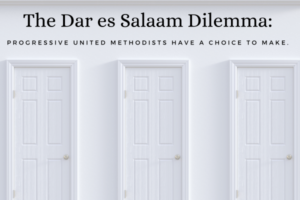 Which will it be at the upcoming UMC General Conference:
Door # 1, Door # 2, or Door # 3?
The long-running daytime TV gameshow, Let’s Make a Deal, is famous for its three-door challenge. Behind one door is a fabulous prize. Behind another is a “Zonk” (a clear loss). And behind a third door is often a middling prize of some sort: choosing this door means you didn’t really win and you didn’t really lose, but you were part of the “game.”
Let’s Make a Deal! came to mind with the reporting that a January 4-7 meeting of progressive, liberationist, and centrist African United Methodists in Dar es Salaam, Tanzania purportedly demonstrated strong African support for a proposal before the UMC General Conference to “regionalize” the denomination.
One African bishop, Bishop John Wesley Yohanna, resident bishop of the Nigeria area, strongly opposes regionalization and links it to the LGBTQIA+ moral and legislative agenda of the progressive/liberationist wing of the UMC. He refutes the narrative that Africans endorse regionalization without condition.
In response, the progressive/centrist MainstreamUMC attacked Bishop Yohanna’s character and his legitimacy as a duly elected episcopal leader. Surreptitiously the MainstreamUMC leaders also conflated some video of the December, 2023 Centennial Celebration of Methodism in Nigeria, which included greetings from Rev. Keith Boyette of the Global Methodist Church, as proof positive in their minds that Bishop Yohanna is, by association, a stooge of the GMC. Even more, MainstreamUMC calls on its supporters to contact the UMC Council of Bishops immediately to “take action against Bishop Yohanna.” (You can read the hyperventilating fund-raising attack on Bishop Yohanna here.) The umbrage of MainstreamUMC about a bishop with whom they disagree is suspect, of course, since they have never questioned the legitimacy of the two clearly ineligible people who have been elected, consecrated, and assigned as UMC bishops in the Western Jurisdiction.
Let’s Step Back a Moment to Consider the Dilemma of Dar es Salaam for the Progressives in the UMC
Who/what is the UM Africa Forum?
United Methodist Africa Forum (UMAF) sponsored the meeting in Dar es Salaam, Tanzania, January 4-7, 2024. The UMAF was founded as a progressive/institutionalist response to Africa Initiative, a traditionalist network of African United Methodists. The Dar es Salaam meeting specifically excluded known traditionalist delegates to the UM General Conference and exclusively promoted the legislative agenda of regionalization. The General Coordinator of Africa Forum, Rev. Lloyd Nyarota, is a consultant for the UMC General Board of Church and Society and, since 2015, serves a two-point charge of the United Church of Canada in Alberta. Donations to Africa Forum are made through the Methodist Federation for Social Action. The point here is that UM Africa Forum is unequivocally a political action advocacy network supporting the progressive/liberationist/centrist agenda for the upcoming UM General Conference.
Why did MaintreamUMC attack Bishop Yohanna and why did UM News Service ignore him in their reporting?
Good question. Ignoring the Bishop’s voice is one way of silencing dissent to the preferred institutional narrative regarding regionalization. Up to this point, United Methodist News Service has not reported on any dissent to regionalization, though others have (see next item below). The MainstreamUMC direct assault on the character of Bishop Yohanna is a time-tested way to distract from the reasons he gave for his opposition to regionalization. Magicians and illusionists often use misdirection, the subtle, deceptive art of directing an audience’s attention towards one thing (a magical effect) so it does not notice another (the method or mechanics of a trick). Perhaps we should check out the bishop’s dissenting perspective rather than pillory him personally.
Is there a connection between the proposal for regionalization and advocacy for the LGBTQIA+ agenda at General Conference?
Actually, it is not a connection between two legislative initiatives, but three: regionalization, disaffiliation, and changing the definition of marriage. You can read a straightforward African dissent to regionalization here. “Regionalization” as a legislative stalking horse for changing the definition of marriage and liberalizing the current UMC Book of Discipline standards regarding sexuality and ordination of LGBTQIA+ persons is profiled in detail here.
I commend the reading of both of those articles in their entirety. However, to see the connection between disaffiliation, regionalization, and the proposal to change the definition of marriage, we need look no farther than the Dar es Salaam meeting itself.
The African United Methodists meeting in Dar es Salaam voted as follows:
- Participants affirmed United Methodist unity over disaffiliation. Hooray for the progressives and liberationists!
- Participants affirmed regionalization. Hooray, again, for the progressives and liberationists!
- Participants opposed any change to the definition of marriage as the exclusive relationship between a man and a woman. Uh-oh…for the progressives and liberationists!
Which will UM progressives/liberationists/institutionalists choose: a fabulous win, another frustrating loss, or something in-between?
Door # 1: Winner Take All
A potential coalition of progressives, liberationists, centrists, and institutionalists could attempt the “winner take all” legislative strategy at the UMC General Conference in April/May. That would mean 1) shutting down any exit paths for conferences and congregations by denying any further process of disaffiliation, 2) changing the definition of marriage, and 3) approving regionalization of the UMC.
This is a challenging choice for at least a handful of reasons:
- The regionalization proposal requires a 2/3 vote of the General Conference and an affirmative vote of 2/3 in the various annual conferences following General Conference. This is a very high bar for organizational change which, even the Africa Forum participants in Dar es Salaam indicated, is a non-starter if the definition of marriage is changed.
- The number of United Methodists in the USA continues to decline while the number of United Methodists in Africa continues to increase. 2024 is perhaps the last General Conference before Africa will have a majority of votes. (Hence, the Council of Bishops indicates it will call a “special session of the General Conference” in 2026 which, unsurprisingly, will continue to use the delegate apportionment formula of 2016 and maintain the present inequitable voting majority for the USA.)
- Maintaining the current definition of marriage as an exclusive relationship between a man and a woman will alienate the votes of LGBTQIA+ advocates. 2024 may be their last opportunity to expand and liberalize the sexuality teachings of the UMC.
- Denying a disaffiliation pathway for Central Conference congregations and annual conferences will tend to guarantee legislative gridlock until at least 2028 when African delegates will likely have the majority of votes at the General Conference.
- Making all three of these changes will generate significant uproar from congregations who have been assured by their bishop and/or district superintendent that there will be either a) no changes at the General Conference or b) there will certainly be an option for disaffiliation should a congregation choose after the General Conference to leave. This, too, will tend to guarantee that the UMC will be stuck in ongoing congregational conflict until at least the next General Conference.
Still, up to this point “winner take all” seems to be the preferred option by the institutional leaders and progressive/liberationist/centrist advocacy groups. As MainstreamUMC puts it:
Most Bishops, the Connectional Table, the Standing Committee on Central Conference Matters, the Central Conference authors of the Christmas Covenant, and multiple advocacy groups—including Mainstream UMC, are all working together for this goal. For it to work, we must dramatically ramp up our collective efforts to pass it.
It is hard to see how a collective effort will hold together when the partners in the coalition identified by MainstreamUMC actually have conflicting legislative priorities.
Door # 2: Zonk! Everyone loses.
This is the “if I can’t win, then you can’t win, either” choice. It portends a repeat of the 2019 Special Session of the UM General Conference that is regularly described as a “dumpster fire.” If you liberalize/expand the definition of marriage, we won’t support regionalization. If you don’t support regionalization, we will oppose any opportunity for congregational disaffiliation. If you don’t support a disaffiliation pathway, we won’t support regionalization.
The progressive/liberationist/centrist adhocracy has in the past promised to continue to dissent, disrupt, and disobey the current standards of the UMC. So, the much hoped-for “dream of the future UMC” will be, again, caught in a thorny thicket of conflict, gridlock, decline, and shrinking resources. For a long read on this progressive strategy, see By the Numbers: How the Resistance Can Stay in the UMC.
This seems like an irrational choice as a legislative strategy, but sometimes movements and organizations make the decision to tear themselves apart. For the UMC to take this tack at the upcoming General Conference would, I think, only increase the urgency of dealing with the organizational issues that currently cloud its future and at the same time render itself nearly incapable of dealing with those urgent needs. The self-destructive image of sawing off a tree branch we are sitting on comes to mind with the purposeful strategy to make sure everyone loses…purportedly because of commitment to a “higher” goal.
Door # 3: You Win Some, You Lose Some… blessed by the name of the Lord!
Do the delegates to the upcoming UMC General Conference want to move beyond the past half-century of denominational conflict? Do General Conference delegates want to release the UMC so it can dream about “the future church”? Do General Conference delegates have it in them to allow those who want to leave to have a fair, transparent, feasible, and accessible pathway to do so…if for no other reason than to being turning the page on this season of disruption?
If so, choose Door #3.
This would require respecting others and allowing for a peaceable parting. Those who want to remain and seek a vibrant, fruitful future for the UMC will be able to do so. And those who want to separate from the UMC for their preferred pathway to a fruitful and faithful future will be able to do so, too.
Both the progressives and the traditionalists could offer each other peace and bless one another on our different but related paths. As a byproduct, Methodism would be multiplied.
The WCA and its coalition partners strongly support allowing a pathway for disaffiliation to Central Conference congregations and annual conferences. That is our priority. Any other choice, it seems, leads only to chronic conflict and, importantly, substituting internal denominational disputes for the larger Jesus Mission. We believe that what is fair for some should be fair for all. We also believe that fair-minded delegates to the UMC General Conference understand this as a matter of simple justice.
The Scriptures observe that “in the spring of the year, kings normally go out to war… “(2 Samuel 11:1). You might think that is in some way an appropriate Scriptural reference for the experience of UMC General Conferences. This year a better choice might be to allow those who want to remain UMC to do so and, at the same time, allow those who desire to disaffiliate to do so, too.
Progressives, liberationists, centrists, and institutionalists will have to make a choice. Call it the Dar Dilemma, but it is a set of choices that will be in the forefront of the UMC General Conference in Charlotte.
Let your General Conference delegates know what you think and how you feel about which “door” should be chosen this year.
And if you want more information on the WCA’s Fair for Some Fair for All campaign, you can click here.