
January 9, 2024
By Rev. Dr. Scott N. Field
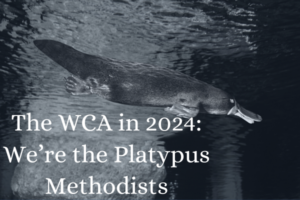 After a recent WCA Outlook, one questioning reader added a Facebook reply:
“I thought the Wesleyan Covenant Association had left the United Methodist Church. Why are they posting things?”
There is, indeed, a lot of dust in the air when it comes to all things Methodist during this time of tectonic denominational transition. It’s understandable that some would be asking, “Who/what is the WCA now that disaffiliations under Book of Discipline, paragraph 2553, are over?” Let me attempt an analogy to clarify who/what we are and provide three reasons we are not only “still around” but engaged and energized to complete our mission.
Who Are We?
We’re the Platypus Methodists.
There’s no shame or shade for anyone attempting to figure out the various camps, caucuses, institutional special interestes, protagonists, antagonists, lobbyists, and leaders in the ongoing parting of the ways among United Methodists. I’ve come to identify many of us in the WCA network as “Platypus Methodists”.
The platypus is frequently given as an example when taxonomy conventions are challenged to determine exactly what kind of creature a creature is. The platypus has characteristics of mammals, reptiles, and birds. So, which is it? The platypus turns out to be in a category largely by itself.
Many WCA Outlook readers are or have been United Methodists, are current or former dues-paying members of the Wesleyan Covenant Association and are or will soon be part of the Global Methodist Church. Many of us, perhaps most of us, have been part of at least two or all three of these groups of Christ-followers. It is important to note that all of us started our journey within the United Methodist Church.
Currently the UMC communications apparatus, social media network, and leadership assert that with the close of 2023, disaffiliation is over, and it is time for the denomination to move on. We don’t see it that way whatsoever. It may be almost over, but in United Methodism right now there is an enormous difference between disaffiliation being over and being almost over. With both the UMC General Conference and the GMC Convening Conference on the horizon, 2024 will be, without any doubt, another year of seismic transitions…whether planned or not.
Here are three ways the Wesleyan Covenant Association is energized and engaged for 2024:
- UMC General Conference Advocacy
The WCA has no interest in reforming the United Methodist Church. We have no clandestine plans to undermine or sabotage the upcoming General Conference. We are part of the wave that is moving out and moving on. We have intense and passionate interest, however, in addressing the institutional injustice that has denied Central Conference United Methodists (Africa, the Philippines, and Europe) from the respect, dignity, and agency to determine their own future in the same way provided for United Methodists in the USA. What is fair for some should be fair for all. Period.
Without question, the UM General Conference in April/May should authorize a fair, transparent, feasible, and uniform process for separation for the Central Conferences. In addition, punitive additional requirements leveled against disaffiliating congregations in several annual conferences in the USA should be repudiated and an avenue for separation in those conferences restored. Overcoming these institutional injustices will allow the United Methodist Church to have a fresh start as it seeks to pivot to a vibrant future. Why would any General Conference delegate want to condemn the continuing UMC to this legacy of injustice, colonialism, and institutional abuse?
Denying congregations an avenue for separation will guarantee another chapter of the chronic internal conflicts that have hobbled the UMC for the past half-century. Do General Conference delegates want to turn the page to plan a new future? If so, the General Conference should allow those who want to leave to do so. Without that option, continuing conflict is the foregone future for the UMC.
- May the Fourth, We’ll Be with You
For many United Methodists, May 4, 2024, will be an unexpected and unwelcome wake up call. For others it will be a long-sought victory in the denominational battles. United Methodists in many cases have been assured by their pastors, district superintendents, and bishops that there will always be room for traditionalists in the UMC. But General Conference decisions, like all legislative gatherings, come down to the math. And the math related to the UMC General Conference skews strongly in favor of the progressive agenda. For example, with over 25% of UM congregations in the US having disaffiliated, many “traditionalist” delegates have left the UMC and been replaced by delegates more favorable to the progressive agenda. This is understandable and expected. In addition, however, letters of invitation for Central Conference delegates, particularly in Africa, which has more traditionalist delegates, have been slow to arrive or have not yet been sent. This delay in receiving letters of invitation almost guarantees that these delegates will be unable to schedule visa interviews authorizing travel to the US. When the inevitable question is asked as to why African United Methodists are not fully represented at the General Conference, the rationale given will be that they could not get visas.
It might be that there are “good reasons” why these letters of invitation are so long delayed. However, if this season of disregard for the Book of Discipline since 2019 has taught United Methodists anything, it has taught us that trust in the administrative and spiritual leaders of the UMC is often betrayed. The outcome of the departure of traditionalist US delegates along with the inability of some Central Conference delegates to obtain visas, whether by default or by design of UMC administrative leaders, will be a General Conference that will likely be more progressive in its outlook.
So what?
The legislative proposals currently favored by UM administrative leaders, progressive advocacy caucuses, and most bishops include these:
- Change the definition of marriage from a covenant “between a man and a woman” to “two people in union with each other”.
- Regionalize the structure of the UMC so that Africa and other Central Conferences are put into the category of “separate but equal” from the USA, a form, as delegates in the Africa Initiative group, call “institutional apartheid.”
- Refuse any opportunity for disaffiliation to be extended to any congregation anywhere at any time.
If those proposals prevail, on Saturday, May 4, 2024, the day after the UM General Conference adjourns, United Methodists in the US and around the world will receive word through their social media networks, secular news sources, and friends, that the assurances they received from their pastors, district superintendents, and bishops were either willfully false or politically uninformed. Many of those United Methodists will conclude they have been lied to. They will be looking for the exit door, in one way or another.
Should the UM General Conference support this progressive agenda, the WCA will still be here on May the Fourth to assist those congregations and church members seeking an alternative.
The WCA is a network of relationships, that has been organized in fifty-three regional chapters, to provide information, encouragement, counsel, resources, and connections for United Methodists seeking a future of fruitful and faithful ministry. We’re part of the bridge for those individuals and congregations who have prayerfully determined that a faithful and fruitful future requires them to leave the United Methodist Church.
You can count on us.
- Welcome to the Missional Community!
When congregations and individual members leave the United Methodist Church, it is certainly an ending. But that intentional ending is undertaken on the threshold of a new beginning.
Some years ago, in an unrelated seminar, I sat near a counselor from the East Coast of the US who had a good deal of experience consulting with congregations that had left the Episcopal Church and the Presbyterian Church (USA). These congregations, she said, were all comprised of conservatives that had chosen to leave their long-standing denominational affiliation to become part of a newly forming network, in these cases either the Anglican Mission in America or the Presbyterian Church in America. The counselor herself was not Episcopalian or Presbyterian. She was a staff consultant from a group focused on the health of Christian congregations.
I asked her about those congregations that left their former denomination. How did they traverse the transition? Did they find themselves struggling with grief or a lack of resources or an outbreak of infighting once the separation was completed? Were there conflicts over pastoral leadership or becoming part of a new denomination or mission?
To my surprise, she replied that after some initial disorientation and letting the dust settle, these congregations were much more united and focused than they had experienced within any church member’s memory. She concluded that being done with the conflicts of their former denomination had unleashed a reservoir of engagement and energy around their agreed upon mission. Far from being a negative, she said that those congregations with which she consulted were uniformly healthier and more vibrant after they had left their former denomination.
One of the reasons the WCA continues is not only to inform, resource, counsel, and assist congregations and individuals to separate from the UMC, but also to welcome them to the missional community of the Global Methodist Church. When we are united on the central matters of the faith, there is wondrous freedom for innovation and creativity around how we will accomplish the mission. The testimonies of congregations that have disaffiliated and the gatherings of the convening conferences of the Global Methodist Provisional Annual Conferences are frequently marked by a palpable joy, freedom, and excitement about their future. Most of them also report experiencing a remarkable trust of one another and an abiding sense of the Holy Spirit’s presence.
Is the Wesleyan Covenant Association still around?
Absolutely so. We are purposeful and passionate; engaged and energized. Though our mission is almost completed, we will not quit until it is fully finished. We are the bridging network of committed believers helping others toward their faithful and fruitful future.