
June 18, 2024
By Rev. Dr. Scott Field
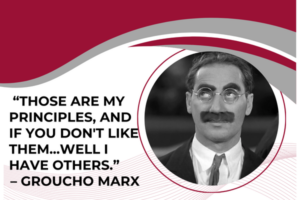 Whether or not this quote attributed to Groucho Marx is authentic, a recent statement by the Northeast Jurisdiction College of Bishops (United Methodist) brought it to mind…along with another familiar statement about “principles”
“If someone says, ‘It’s not about the money; it’s the principle of the thing’, you can be pretty sure it is about the money.”
In the ongoing division of the United Methodist Church both in the USA and internationally, on all sides and everywhere in between, there are appeals made to various “principles”: Wesleyan heritage, Scriptural authority, justice, truthfulness, grace, fairness, integrity, the “global consensus of the General Conference”, and so on. If you are not aware of the statement released last week by the UM Northeast Jurisdiction College of Bishops (covering the geography roughly form West Virginia north and east up through Maine in the USA), you can read it here.
I want to make two observations about the bishops’ statement, note that there are some bishops with a more gracious and affirming stance toward separations for the time being, and, more importantly for most readers of the WCA Outlook, ask about the “principles” of those of us who seek to be allies and advocates with others, in the USA and internationally, who are seeking to leave the UMC to become part of the GMC.
I am not attempting to “prove” the bishops wrong or the WCA-ers right; I am attempting, however, to sweep the dust away from some of the principles involved in the wrenching decisions that have brought the UMC either to its irreversible irrelevance or its bracing rebirth, depending upon your perspective…and, well, your principles.
What did the bishops say? What did the bishops mean? Can any of it be taken seriously?
These two principled stands of the bishops seem to be clear:
- The UMC General Conference provided absolutely no option for continuing congregational disaffiliation for any reason whatsoever; the NEJ bishops will not allow for any congregations whatsoever to disaffiliate in 2024 or beyond since paragraph 2553 has expired. Period.
- “Now that disaffiliations have concluded, the College of Bishops will ensure that annual conferences receive the best value for any sold property.” The bishops can be counted on to get the best price for any “closed” church properties that are “sold”. The bishops and annual conference boards of trustees are, after all, guardians of the UM institution so, the principle really is about the money.
These two “principles” (that is, no more disaffiliations and seeking the “best value for property”) are to be taken seriously.
Though the bishops were, I presume, sincere throughout the composition of this letter, they cannot be taken seriously on at least two other points:
- No one will be expected to change their traditionalist beliefs.
“…, the College of Bishops will commission a small team of theologically diverse clergy and laity to create a resource to assist congregations in understanding the changes made by the General Conference regarding human sexuality and working through weddings and appointments. This resource is intended to provide a healthy process to (re)build relationships, listen to learn and reflect theologically on this matter from our distinctive Wesleyan perspective so congregations can discern how to move forward. No clergy or laity will be asked to change their beliefs.”
I don’t know the actual metrics used in the Washington Post’s famed Pinocchio scale of outlandish whoppers, but I would peg this statement by the bishops as at least a 3 on the Pinocchio Scale. United Methodists have spent a half-century in “theologically diverse” conversations. Where have we ended up? We are a house divided. Hence, we are a church that has separated into two. The bishops can write a statement on the principle of “unity in diversity”, but as Bishop Thomas Bickerton said (repeatedly) in his opening address at the General Conference, if you can’t get with the agenda of the United Methodist Church, perhaps you should leave. The shorthand principle for this is “put up or shut up.” We are all way beyond the canard that theological differences “don’t really matter.” They do matter; that is why United Methodism is torn asunder.
- No church or clergyperson will be pressured to officiate or host same-gender weddings.
“You may have read or heard that the Global Methodist Church and other non-UMC groups and individuals have said that United Methodist clergy will now be forced to perform same-gender weddings and that our congregations will be required to permit same-gender weddings. This is NOT true. The General Conference passed legislation that prevents district superintendents andbishops from penalizing pastors and churches that refuse to perform or allow a same-gender wedding on their property. No clergy will be forced to perform same-gender weddings, and no congregation will be required to permit same-gender weddings on their premises. Clergy and congregations are now entrusted to make these decisions gracefully, considering their ministry context based on their beliefs and attitudes regarding ministry with and by LGBTQ persons.”
This is the same wink-and-nod assurance the Episcopal Church (USA) gave to clergy when that denomination affirmed same-sex weddings. But in fact, when Episcopal Bishop William Love (Albany, New York), for example, differed from the denomination’s decision and prohibited same-gender weddings in his diocese, he ended up on trial and was found guilty of not supporting the denomination’s Resolution B012 affirming same-sex weddings. Bishop Love left the Episcopal Church to become part of the Anglican Church in North America. (Read more in a Google search or, for a summary, click here.
It seems ironic, but notable, that the NEJ bishops highlight the UM General Conference vote to move forward toward full communion with the Episcopal Church (USA). The recent UM affirmation of same-gender weddings does indeed align us with the Episcopalians (1.6 million members) at the same time it alienates the UMC from the Roman Catholic Church, the Orthodox Churches, and Worldwide Anglicanism (approx. 1.8 billion Christians overall – that is “billion” with a “b”.)
There are a few options yet remaining….
I should note during Methodist’s traditional Annual Conference Season (May-June), that there are a few annual conferences in the USA where a process is either in place or is being developed to allow for further separations which will be presented to their respective 2025 Annual Conference Sessions provided, for the most part, that all the paperwork is in by the end of 2024. If this is of interest to your congregation, check with your District Superintendent. In July, WCA Outlook will include the listing of annual conferences publicly extending a continuing exit path. This seems the commonsense approach that allows congregations to land where they want to land. We are grateful for the gracious option.
It actually is the principle of the thing.
I have highlighted what I consider to be both the underlying principles and the dubious assertions in the letter of the UM’s Northeast Jurisdiction bishops. But their principles are not the point for most of us who are experiencing a calling, a stirring, a conviction, a dawning realization, that we need to leave the UMC for a more faithful and fruitful future in following the Lord Jesus.
The “look yourself in the mirror”, examine your own soul, exercise for each of us requires that we sweep away the dust of our own secondary and tertiary “principles” to get to our own foundational convictions of conscience.
Most of us are likely familiar with some of the considerable, but secondary “principles” we may have been contending for in our local churches:
- We want to keep the impact of the last UM General Conference decisions away from our local church. We like things the way they are.
- We want to select our own pastor; we do not trust the “system” of the UMC to provide genuinely converted, biblically literate, pastorally sensitive, evangelistically committed, Great Commission-minded leaders for us.
- We want to control the property of our church.
- We don’t know how to engage the chaotic culture around us; we want our church to be an island of calm in a sea of change.
- We’ve been part of the same congregation for decades; we just want to grow old together. Maintaining our church community is most important to us and there aren’t many of us left.
These principles certainly may motivate us. We might just keep fighting with the UMC over principles like these.
Let me suggest that you prayerfully consider exchanging those principles for a more foundational commitment. If we are fighting to maintain control, fighting to keep things the same, fighting to shield ourselves from the challenges of the times in which we live, feverish to find the perfect pastor, youth worker, marketing plan, or church website to secure our congregation’s missional future, we are likely on the road to continual disappointment.
There really is a revival building. New wine is being poured out and old wineskins simply cannot hold it. The Holy Spirit is stirring things up…maybe you are experiencing it, too.
So don’t hold back.
We are being sent together, under the influence of the Holy Spirit, for the healing of the world in Jesus’ name. Don’t settle for anything less.
We may oppose the principles of the UMC’s denominational leaders, but honestly, we will not change them. So perhaps we should stop trying. Besides, we have our own principles. Let’s move on, friends. One way or another. Let’s move on.
Need some help? Start by checking out our expanding resource collective here.