
March 12, 2024
By Rev. Dr. Scott Field
 I am sure you and I have the same experience: sometimes things we hear go in one ear and right out the other. Estimates vary widely, but most of us hear somewhere between 20,000 and 30,000 words every day. No wonder a lot of those words just go on by without us paying much attention. But there are some words which we cannot unhear. They strike something within us. Whether they are precious words or worrisome words, we cannot ignore them.
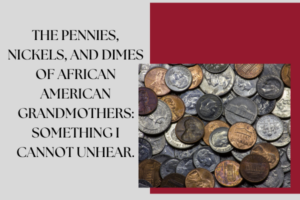
The pennies, nickels, and dimes of the African American grandmothers got me that way.
Here’s what happened:
A couple of weeks ago we recorded a podcast interview with Rev. Helena Titus. She is a native of Los Angeles, California where she has a long and deep family history of public service and community involvement. Rev. Titus is a former public-school teacher, special education advocate, and vocational rehabilitation consultant. She is a graduate of Simmons College and earned her Master of Divinity degree at Claremont School of Theology. She was appointed as a pastor while an ordination candidate in the United Methodist Church. Now, however, she is the pastor of First Global Methodist Church of Los Angeles. It’s a hybrid congregation that meets in person each month but meets online each week. Many refer to her affectionately as Rev. H, Your Personal Pastor, and have responded to her encouraging and inspiring messages of hope by collectively viewing them over 100,000 times through her Restoring Hope Christian Fellowship online ministry.
Rev. H has an impressive resume. She’s leading an innovative new church. But it was her words during the podcast interview that I cannot unhear. I asked her about United Methodist Churches in her former annual conference that had considered disaffiliation in the past year or so. She echoed common themes reported from other annual conferences:
- Silence from the bishop or conference officials about any discernment or disaffiliation process.
- Attacking or insulting any pastors who shared information or passed along resources about disaffiliation.
- Threatening local pastors with immediate removal and loss of their livelihood if they supported the distribution of information or congregational meetings discussing the church’s relationship with the UMC.
But her UM annual conference added something to the general disaffiliation requirements of paragraph 2553. Besides paying two years of apportionments and unfunded pension liabilities, the conference required 50% of the market value of the church property. This is Los Angeles, California. Fifty percent of the market value was easily in the millions of dollars for the churches in the city.
That’s when things got personal. Rev H. related:
My grandmother and her five friends and my mother and her elderly friends, scraped together their pennies, nickels, and dimes to build the church in the first place …and now they have to buy it back from the conference? These are African American women. African American women are among the lowest paid people in the country. All of them are on pensions. Where are they going to get that kind of money? Disaffiliation was never allowed to be an option.
(I am summarizing and condensing here.)
The podcast will be available on March 21. You’ll be able to listen to the whole thing. And maybe you, too, will not be able to unhear those words about the pennies, nickels, and dimes of the African American pensioners. The grandmother and her friends would never say it this way, of course, but the bishop and conference leaders of the denomination that had been their spiritual home for decades is holding them hostage.
They aren’t the only ones.
Don’t Forget Us!
In our recent WCA Outlook posts I have frequently focused on how disaffiliation has been available exclusively to United Methodist congregations in the USA. The restriction of the disaffiliation process that has denied agency and opportunity for the Central Conferences in Africa, the Philippines, and Europe is an injustice that the upcoming UM General Conference can and should correct.
But the provisions of disaffiliation, as it turns out, have not been evenly administered within the USA. Thankfully, many of the UM annual conferences in the US have developed and administered a clear, straightforward, and feasible pathway to disaffiliation in keeping with paragraph 255. Others, however, have added onerous financial requirements, near-impossible timelines, and/or suppression of information or presenters. One email I received not long ago from a pastor carried the plaintive subject line: “Don’t forget us!” He was and is strongly in favor of Central Conference UM churches having a fair, transparent, feasible, and uniform exit path if they should choose to disaffiliate. But he reminded me that some annual conferences in the US have added requirements which make it impossible for any congregation to leave. The provision authorized by the General Conference of 2019 allowing an option for congregations to separate over matters of conscience after a 2/3 congregational vote has been rendered null and void, for all practical purposes, by bishops, trustees, and administrative leaders in a handful of US annual conferences.
Some UM activists and influencers allege in their social media posts that the Wesleyan Covenant Association and Good News have no business even showing up at the UM General Conference because, as they say, disaffiliation is over; paragraph 2553 is no longer operative. Au contraire. Despite the status of paragraph 2553, disaffiliation cannot be over as long as the injustice is left unaddressed.
What is fair for some should be fair for all. And what has been ably administered on behalf of most United Methodist churches in the US should also be available for all who desire to consider and, if they so choose, follow the path of separation.
The WCA will be ready to pack up and leave Charlotte as soon as the General Conference approves a disaffiliation pathway available to all United Methodist congregations and annual conferences everywhere that is fair, transparent, uniform, and feasible. Its just that I cannot unhear what is happening, in the name of the United Methodist Church, to the African American grandmothers in LA.
How can disaffiliation be over if the UMC ignores its own injustice? Among the many things the UMC will want to carry into its future, surely this is not one of them. The General Conference can set this right next month. Delegates convene in just six weeks.
If you want to hear more from the “unheard” voices, check out the WCA’s limited podcast series, Short Takes on Hot Topics. A new episode drops every two weeks until the General Conference convenes in Charlotte.